

If you run a fleet with a heavy COA book, the core scheduling challenge is familiar. 80% of your cargoes are committed. The program is set. The question is how efficiently you sequence them, and what you do with the capacity left over.
That remaining 20%, the spot cargoes your team picks up to fill positioning gaps and boost utilization, is where the real scheduling leverage lives. It's also where the most value quietly leaks away.
The committed program is only the starting point
A COA book gives you baseline revenue and planning certainty. But certainty of cargo isn't certainty of schedule. Every planner working a fleet of twenty or thirty vessels against a dense contract program knows that sequencing options are vast, and that small differences in vessel assignment and port rotation compound across the quarter.
Assign the wrong vessel to a contracted cargo (not wrong because it can't do the job, but wrong because it creates a longer ballast leg to the next commitment) and you've burned two days of bunkers and closed a window that a better spot fixture could have filled. The individual voyage still looks profitable. The schedule, taken as a whole, underperforms.
Multiply that across 40 or 50 committed voyages a quarter, and the drag on fleet-level TCE becomes significant. Not because anyone made a bad call, but because the optimization problem is simply too large to hold in your head or in a spreadsheet.
Two hundred spot cargoes. Which twenty matter?
On any given week, there might be a hundred or two hundred cargoes in the market your vessels could technically lift. The problem isn't supply, but rather the evaluation speed.
To properly assess whether a spot cargo is worth pursuing, you need to understand how it interacts with your existing committed schedule. Does it slot cleanly between two COA voyages? Does it reposition a vessel toward its next obligation, or pull it away? Does accepting it create a conflict three weeks out that isn't visible today?
These aren't questions a planner can answer quickly for two hundred cargoes against a live fleet schedule. What happens in practice is triage by instinct. The team eyeballs the list, filters by region and laycan, runs estimates on the ones that look promising, and makes a call. The shortlist might be reasonable, but reasonable is not optimal, and a cargo screened out in the first 30 seconds might have been the best option.
What if your team could evaluate all two hundred options against the full forward schedule and have a ranked shortlist of the 20 worth serious consideration in minutes? That's what scheduling technology built for fleet-level optimization actually does. It doesn't replace the planner's judgment on which cargo to fix, it simply ensures their judgment is applied to the right shortlist.
The complexity multiplier
If your fleet moves breakbulk, project cargo, or multi-purpose cargoes, the challenge is harder still. It's not just about matching cargo to vessel to laycan- it's stowage constraints, crane ratings, multi-parcel voyages with complex port rotations, and the interaction effects between cargoes sharing the same hold space.
In chemical tankers, the complexity increases by another order of magnitude. A single vessel might have 30 or 40 tanks, each with its own coating type, heating capability, and cleaning requirements. Every parcel loaded impacts what can go in the adjacent tank. Every cargo carried previously determines what can be loaded next. The scheduling problem becomes which tank, which sequence, which cleaning regime, and whether the combination of parcels across a ten-port voyage is even physically and chemically compatible.
A consolidation opportunity across six parcels and four discharge ports might deliver significant savings on freight and port costs, but it only becomes visible when you can see every hold, every tank, every restriction, and every port call across the full voyage simultaneously. Layer in bunker optimization, port cost allocation, and the financial impact of frameworks like EU ETS, and you're looking at a decision space that grows exponentially with every additional tank and port call. The best a planner can do manually is find an answer that works. The question is how far that answer sits from the one that works best.
Better questions, not just faster answers
The real value of fleet-wide scheduling visibility is that it changes the quality of the questions your planning team has the answers to.
Restrictions in manual planning make "does this cargo work for this vessel?", a reasonable question for a planner to ask. With fleet-wide optimization, the planner can quickly answer more detailed questions like, "which of these spot options positions our fleet best for the next sixty days, given our COA commitments, current bunker prices, and the ETS implications of each routing?" With manual planning only, the planner has all of the same questions, but no ability to quickly answer and act on them.
This shift is where TCE improvement actually lives. Not in squeezing individual voyage margins, but in making decisions that keep the entire schedule - contracted and spot - together, performing at a higher level over time. The planner still makes the call. What changes is what they can see when making it.
The schedule that looked good enough
All of this leads to a particular kind of loss that never shows up on your P&L. It accumulates quietly, voyage by voyage, in the gap between the schedule you're running and the schedule you could have been running.
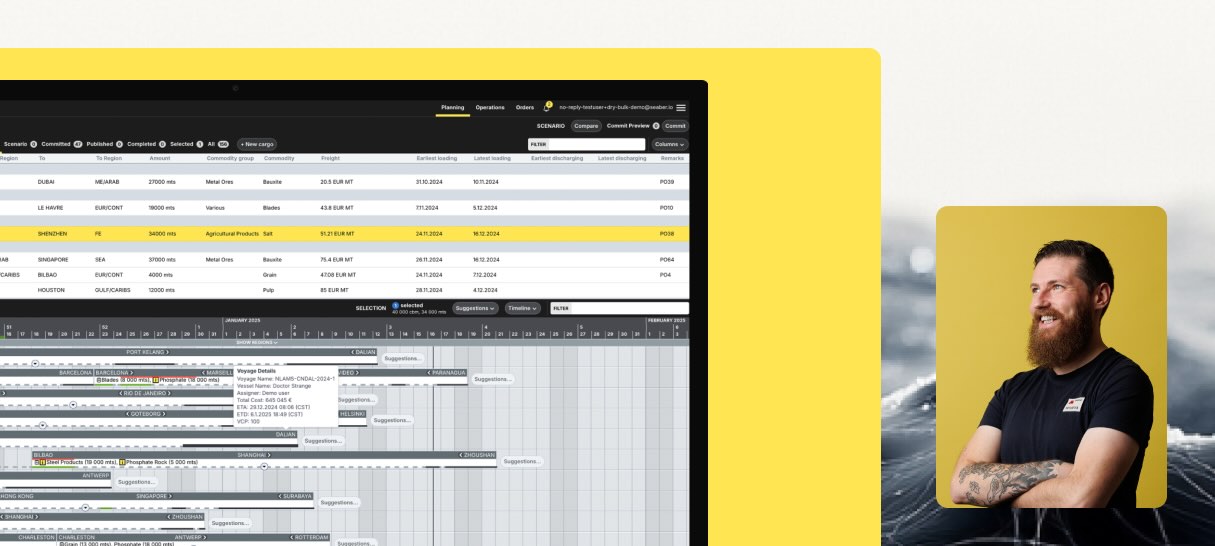
That gap is the cost of good enough. At Seaber, it's the problem we've built our platform to solve: giving fleet operators the visibility and speed to optimize a large fleet against a complex COA program, and to find the spot cargoes that make the whole schedule work harder. If that's a conversation worth having, we'd welcome it.